|
3 Transistor Audio Amp 50 Milliwatt - Here is a little audio Amplifier similar to what you might find in a small transistor radio __ Designed by Bill Bowden
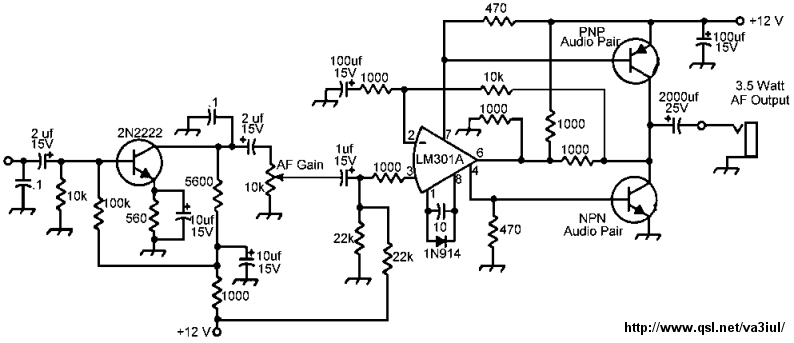
3.5W Low Distortion Audio Power Amplifier - Schematic only __ Designed by va3iul
3: 5 Watt Class-A Audio Amplifier - Behaves like a one-valve operated Amplifier Simple circuitry No cross-over distortion __ Contact: Flavio Dellepiane, fladello @ tin.it
30 Watt PA For 80 Metres - Q1 and Q2 are IRF521 MOSFETs. The input transformer is 6 turns trifilar wound on a pair of stacked Ferrite cores. The output transformer primary is 1 turn, centre tapped, of brass tubing. I used a section of telescopic aerial from a portable radio. Perhaps I got a bit carried away, but I removed the chrome plating in an effort to reduce RF losses due to skin effect. The output transformer secondary is 3 turns of insulated wire. The transformer core is made from 6 Ferrite toroids,
3 on each brass tube. The end plates are made from
single sided PCB __
© 1998-2020 Nizhny Novgorod
30 Watt Power Amplifier - This is an unusual circuit for an ultra-low distortion power amp. According to my original notes the circuit is dated January 1977 so the circuit is not exactly modern but it is still sufficiently different to be interesting. The circuit was designed and sold as a card by a purveyor of surplus components but, even using mostly manufacturer's rejected transistors, we managed to get about 0.02% total harmonic distortion at 30 watts with a ±25v power supply into 8 ohms. : no bad figure even in these days of MOSFET and ICs. In 1977 anything below 0.1% was considered excellent. And this figure was pretty repeatable without doing much selection. __ Designed by Richard Torrens
300 Watt MOSFET HI-FI Power Amplifier - The amplifier consists of two completely separate monaural amplifiers each channel has its own power supply, resulting in zero inter-channel cross talk, a common phenomenon in amplifiers sharing the same power supply. In order to obtain the full output power each supply transformer should be rated at 40VAC, 0, 40VAC at 640VA. Unlike many designs relying on the reservoir capacitors to supply peak currents, I prefer to have the raw power available from the transformer resulting in much faster transients.
300 Watt Subwoofer Power Amplifier - There are some important updates to this project, as shown below. Recent testing has shown that with the new ON Semi transistors it is possible to obtain a lot more power than previously. The original design was very conservative, and was initially intended to use 2SA1492 and 2SC3856 transistors (rated at 130W)with 200W (or 230W) devices, some of the original comments and warnings have been amended to suit. __ Designed by Rod Elliott ESP
30W + 30W Amplifier - Schematic Only __ Designed by Collin Mitchell
30W Class AB Amplifier - This is an instrument amplifier for monitoring music when on stage. It provides 21W output power of this little design. Previously I had a decent 10W amplifier (RED Free Circuits) , but we blew that one somehow. Now I will put this into the old box. I haven't built it yet, but the simulations say it works as I designed. In this design, wiring is important due to no differential amplifier. I might need to add ripple rejection with a zener as in the above design. __ Designed by Marc
30W MOSFET Audio Amplifier - This project was a sort of challenge: designing an audio amplifier capable of delivering a decent output power with a minimum parts count, without sacrificing quality. The Power Amplifier section employs only three transistors and a handful of resistors and capacitors in a shunt feedback configuration but can deliver more than 18W into 8 Ohm with <0.08% THDAT1KHz at the onset of clipping (0.04%AT1W, 1KHz and 0.02%AT1W, 10KHz) and up to 30W into a 4 Ohm load.
32 Watt Stereo Amplifier - A 32 Watt per channel stereo power amplifier made using the TDA2050V monolithic integrated circuit. __ Designed by Andy Collison
3-Input Stereo Audio Switcher - Need more analog audio inputs for your stereo amplifier or home-theatre set-up? This 3-Input Stereo Audio Switcher will do the job. It works with an infrared remote control or you can just press one of the front-panel buttons to select a program source. __ SiliconChip
3Khz Filter + Audio Amplifier - This circuit is the audio amp section for a complete optical transmitter. The circuit amplifies and filters the voice audio signals from an electret microphone. The circuit is described in more detail in . . . Hobby Circuit designed by David Johnson P.E.-June 4, 2000
3Khz Low Pass Filter Plus Audio Amp - This circuit uses a switched capacitor filter IC from National Semiconductor to filter signals with frequencies higher than the 3KHz needed for voice audio. The schematic includes an audio amplifier that is designed to drive a standard audio head phone. . . Circuit by David A. Johnson P.E.-June 4, 2000
3-Transistor Modulator-Amplifier Works with Swept-Control Frequencies - 04/22/10 EDN-Design Ideas Many applications require a circuit to perform pulse modulation and voltage amplification to drive a load with a train of impulses. A typical application is driving a piezoelectric generator in a robot. Other applicat Design by Horia-Nicolai L Teodorescu and Victor Cojocaru, Gheorghe Asachi Technical University, Iasi, Romania
4 channel power Amplifier with bi-amping & bridging options - After building the Micro-Amp, I was not only impressed with the performance of the LM4780, but also felt ready to tackle a more ambitious metalwork project. This is the result: four channels, with options for bi-amping and bridging. __ Designed by Mark Hennessy
4 Channel Stereo Audio Selector - The add-on circuit presented here is useful for stereo systems. This circuit has provision for connecting stereo outputs from four different sources/channels as inputs and only one of them is selected/connected to the output at any one time
4 MHz Amplitude Modulated RF source - A while back I needed an amplitude modulated signal source at 4 MHz. This circuit was literally thrown together with parts laying on the bench. I built it dead bug style on a piece of copper clad board. It should work with little or no modification, other thano get it to oscillate, and at higher frequencies, you might have to reduce the capacitor values a little. Just be __ Designed by Dick Cappels
4 X 15 Watt power Amplifier by TA8215 - A lot of electronic circuits in the domain of audio amplifiers are already been published here. This circuit is a little different because it is a four channel amplifier. Each channel of this amplifier can deliver an output of 15Watts into a 4 ohm speaker. The amplifier can be operated from a single 12V DC supply and this makes it possible to use this amplifier in car audio applications too
40W Audio Amplifier by TDA2030 - This is a very excellent 40W power amplifier design using TDA2030 IC and two transistors. The circuit employs only few components and does not require a dual power supply. The input signal is coupled to the non inverting input of TDA2030 through the DC decoupling capacitor C5.
45 Watt Class B Amplifier - Easy to buildNo setup required; Easy to buildNo setup required __ Contact: Flavio Dellepiane, fladello @ tin.it
45W HEXFET Power Amplifier - An ideal solution to make a good, low cost power amplifier. __ Designed by Sam
4-Channel Multi-Mode Audio Amplifier - Sometimes we need configurable multichannel amplifiers for experiments or for use in offices or schools. Here is a circuit based on TDA1554Q, configured for multi-mode function with four channel outputs.Circuit and __ Electronics Projects for You
4-Transistor Amplifier for Small Speaker Applications - The circuit above shows a 4-transistor utility amplifier suitable for a variety of projects including receivers, intercoms, microphones, telephone pick-up coils, and general audio monitoring. The amplifier has a power isolation circuit and bandwidth limiting to reduce oscillations and "motorboating" __ Contact: Charles Wenzel of Wenzel Associates, Inc.
4-Transistor Transmitter - 4 Transistor Transmitter
+ Parts Lits + Notes __ Designed by Paul C. Sherby
5 Band Graphic Equalizer using a Single IC/Chip - This circuit uses a single chip, IC BA3812L for realizing a 5 band graphic equalizer for use in hi-fi audio systems. BA3812L is a five-point graphic equalizer that has all required functions integrated onto one IC. IC is comprised of five tone control circuits and input and output buffer Amplifiers __ Designed by Paul S
5 watt Audio Amplifier using TDA1010 - Schematic only __ Designed by Guy Roels ON6MU
5 Watt Class-A Audio Amplifier - In the old valve days, most commercial audio amplifiers suited for compact integrated mono or stereo record players used a one-valve amplifier topology. The circuit was usually implemented by means of a multiple type valve, e. g. a triode pentode ECL86. Common features for those amplifiers were: Class A operation, output power in the 3, 5W range, input sensitivity of about 600mV for full output power, THD of about 3%AT3W and 1KHz. Best types showed THD figures of 1.8%AT3W and 0.8%AT2W. This solid-state push-pull single-ended Class A circuit is capable of providing a sound comparable to those valve amplifiers, delivering more output power (6.9W measured across a 8 Ohm loudspeaker cabinet load) , less THD, higher input sensitivity and better linearity.
5 watt mini-amplifier 28Mc (or 27Mc CB) with one transistor - Ham RadioV-U)HF AMPLIFIERSchematic __ Designed by Guy Roels ON6MU
5 Watt UHF TV Amplifier - This small circuit is a Linear amplifier for driving small UHF TV transmitters. Its gain is 7dB and can amplify a signal between 450-800 MHz. You can drive the circuit with 1 to 1,5 Watts signal. Better use double layer PCB with the second layer connected to earth. Use a stabilized power supply 25 volts and at least 5Amps. The transistor case is the SOT-122A and be careful because the transistor is very toxic for your health. Tuning can be achieved turning the two variable capacitors. Do not forget to use heat sink for both transistors, specially for the BLW89 and it would be better if you place a small fan as well.
5,000W ultra-light, high-power Amplifier, without switching-mode power supply - This circuit is of an 2x 2, 500W RMS stereo amplifier, super-light and without switching-mode power supply. The circuit just shows a channel, and the power supply that it assists to the two channels. The audio circuit should be duplicated, but the power supply assists to the two channels without problems __ Contact: IQ Technologies
5.8 watt audio power Amplifier - A simple and very cheap audio power amplifier
50W Amplifier - This is a handy, easy to build general purpose 50 watt amp. The amp has an input for a radio, TV, stereo or other line level device. It also has a phono input for a record player, guitar, microphone. __ Designed by Aaron Cake
50W Audio Amplifier using ICL8063 - This simple circuit mixes two or more channels into one channel (eg. stereo into mono). The circuit can mix as many or as few channels as you like and consumes very little power. The mixer is shown with two inputs, but you can add as many as you want by just duplicating the "sections" which are clearly visible on the schematic. __ Designed by Aaron Cake
50W Audio Power Amplifier - This simple audio power amplifier was originally designed for a circuit board workshop, conducted by the OSU IEEE Student Group. At the workshop, 20 participants each constructed this amplifier. __ Designed by Paul Stoffregen-Designed Winter 1995 for the OSU IEEE Student Group Circuit Board Workshop
50W monoblock version of the "Engineer's Amp" - I wanted to keep the deign economical, so no fancy parts are used. The power transformer is a guitar amp (Fender 100W) transformer, Hammond 290FX or similar from the guitar amp winders. Relatively cheap and readily available. The OPT is a plain ole' Hammond 1650N. Of course, you could use Edcor or something else. __ Designed by Pete Millett
5-Band Graphic Equaliser - This equaliser uses low-cost op-amps. Good-quality op-amps powered by a single voltage supply are readily available in the market. The op-amp should have a noise density of less than 24nV/ VHz, __ Electronics Projects for You
5-Band Graphic Equalizer - This complete high quality, low noise 5-BAND GRAPHIC EQUALIZER circuit is based around Monolithic Linear integrated circuit LA3600 manufactured by SANYO. This circuit is very easy to build and has good Quality. You can use it with Portable component stereos, tape-recorders, radio-cassette recorders, car stereos etc. It is On-chip one operational amplifier. __ Designed by YMYA electronics-IZHAR FAREED
5W Inverter - Scroll to this one. A single transistor is all you need for this simple inverter. The main aim of this circuit is to provide a suitable supply for all kind of low power battery chargers that normally connect to the mains such as mobile phones, electric shavers, etc, even an electronic neon light rated at 5W was successfully connected. __ Designed by di Domenico Di Mario |