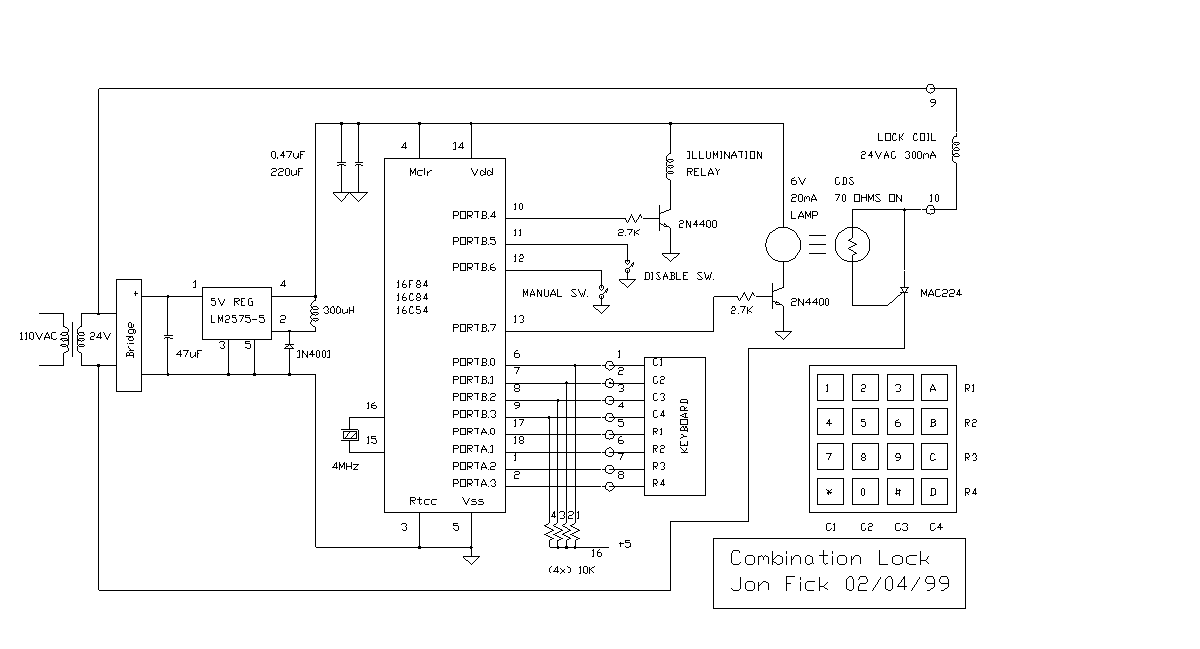
| Combination lock - Operate your gate or something different by this simple electronic combination lock. The combination can have a chosen length of numbers or alphabets, and can be changed any time. The LCD display is optional, the circuit works fine without it. After entering the correct combination, a relay is operated for the predefined time __ Designed by Peter Jakab Combination Lock - Schematic Only __ Designed by Jon Fick
Combination Lock - Combination lock are nice to enable alarms, but are useful for controlling a wide range of electric devices. These software keys can open gates, garages, TV sets, telephones, VCRs, well pumps. . . In practice this circuit is capable to lock or time all the devices that can be connected to relays. __ Designed by Projects & Ideas from Nutchip.com
Combination Lock - The Circuit Board is Designed to accept 2 types of Drive transistors. I Used a 2N3906 in this schematic, but for Higher Current Drive for a Solenoid, You can use Various T0-220 PNP types of transistors. USE ONLY ONE OR THE OTHER, NOT BOTH. In the Picture, I just put a Resistor and LED, where the Solenoid should go. __ Designed by G.L. Chemelec
Combination Locks - This circuit uses 4013 D-type bi-stable flip-flops (D stands for data). Each flip-flop has a data input and a clock input. The voltage applied to the input is transferred to the Q output at the instant when the clock input goes from 0 to 1. (We say these flip-flops are "edge-triggered".) Switches 1, 2, 3 and 4 are the switches which form the code and any number of "wrong" switches can be connected, in parallel, at the point shown. __ Designed by © David Hoult
Combination Lock - a digital lock with keypad - enter the correct code to operate a solenoid. Based around ua3731 __ Contact P. Townshend - EduTek Ltd
Combination Lock2 - a digital lock with switches. A nifty circuit I'm chuffed with, based around just 2 logic ICs ! __ Contact P. Townshend - EduTek Ltd
Digital Combination Lock - A multiple input combination loack using CMOS counter IC 's. Flexibility and code change is allowed by changing output connections. __ Designed by Andy Collison
Digital combination lock using paIR of CD4 013 CMOS chips - The Circuit Board is Designed to accept 2 types of Drive transistors. I Used a 2N3906 in this schematic, but for Higher Current Drive for a Solenoid, You can use Various T0-220 PNP types of transistors. USE ONLY ONE OR THE OTHER, NOT BOTH. In the Picture, I just put a Resistor and LED, where the Solenoid should go. __ Designed by G.L. Chemelec
Digital Electronic Lock - The digital lock shown below uses 4 common logic ICs to allow controlling a relay by entering a 4 digit number on a keypad. The first 4 outputs from the CD4017 decade counter (pins 3, 2, 4, 7) are gated __ Designed by Bill Bowden
Digital Keypad Combination Lock - This simple circuit is the electronic version of the combination lock. Using the special purpose LS7220 digital lock IC , the circuit allows a 4 digit combination of your choice to activate a relay for a set period of time. This relay can then be __ Designed by Aaron Cake
Digital Keypad Combination Lock - This simple circuit is the electronic version of the combination lock. Using the special purpose LS7220 digital lock IC , the circuit allows a 4 digit combination of your choice to activate a relay for a set period of time. This relay can then be __ Designed by Aaron Cake
Digital Lock - The Circuit Board is designed to accept 2 types of Drive transistors. I Used a 2N3906 in this schematic, but for Higher Current Drive for a Solenoid, You can use Various T0-220 PNP types of transistors. USE ONLY ONE OR THE OTHER, NOT BOTH. In the Picture, I just put a Resistor and LED, where the Solenoid should go. __ Designed by G.L. Chemelec
Door lock cancellation switch - This is the circuit where can open the door of the car even if there be not a key. The switch that cancels door lock is set up to the car __ Designed by Seiichi Inoue
Electronic Bicycle Lock - The electronic bicycle lock described here is a worthwhile alternative for bicycle owners who want to make their bicycles 'intelligent' at reasonable cost. One of the benefits of building it yourself__ Electronics Projects for You
Electronic Card Lock for Appliances - The circuit presented here can be used as a lock for important electronic and electrical appliances. When a card is inserted inside its mechanism, depending upon the positions of the holes__ Electronics Projects for You
Electronic Combination Lock - This 7-digit combination lock can be easily hard-wired for any combination that you choose. The circuit uses a 4-bit, divide-by-8 Johnson counter (IC 1) , ten pushbutton switches and npn transistor T1. At power-‘on, ’__ Electronics Projects for You
Electronic combination lock based on PIC - This is my electronic combination lock to use with an outdoor gate. The functionality is implemented in software. It turns on a relay (usually to open a door) for a few seconds. Uses a PIC 16F84A. __ Designed by Peter Jakab
Electronic Combination Lock with AVR - CodeLock AVR electronic combination lock is realised with Atmel AVR microcontroller AT89C2051 or AT90S2313 or ATtiny2313 or ATtiny45. Program in hex code is 2 kB long. One user code (Ver. 1) is consisted of 1 to 8 digits. One user code (Ver. 2.1, 2.2, 2.3) is consisted of 1 to 4 digits. If you buy the chip (Ver. 2.1, 2.2, 2.3) than you can enter 1 or 8 user codes that are consisted of 1 to 9 digits.
__
Electronic Door Lock - Home burglary incidents are on the rise. Homes without proper security measures in place are particularly more vulnerable. But, it is easy to avoid home break-ins by using a simple solution__ Electronics Projects for You
Electronic key - This electronic circuit turns on a relay by pressing four keys in the correct order. The circuit works by a CD4017 and a combination of logic gates.
At the start condition the CD4017 turns on the first output, which is connected to the first gate of the CD4081. By pressing the correct key (P1) both inputs of that gate take the high level. __ Designed by Andrea-Central Italy
Electronic Lock - The digital lock shown below uses 4 common logic ICs to allow controlling a relay by entering a 4 digit number on a keypad. The first 4 outputs from the CD4017 decade counter (pins 3, 2, 4, 7) are gated __ Designed by Bill Bowden
Electronic Locker - This circuit is an Electronic Locker. It is controlled by a switches combination (by a code). There is a switch matrix on the door of the locker. This one is a unit of switches connected into 4 arranged of 4 columns for a total of eight terminals__
Electronic safety lock based on ATtiny26 - This safety-lock can be work with up to 8 different telecards (empty or not) as access keys. Each telecard can be registered or unregistered from the system, by press the corresponding button. __ Designed by © Vassilis Serasidis
Electronics Card-Lock System - The circuit presented here can be used as a lock for important electronic/electrical appliances. When card is inserted inside its mechanism, depending upon the position of punched hole on the card, a__ Electronics Projects for You
Enhanced 5 Digit Alarm Keypad - This is an enhanced 5 digit keypad which may be used with the Modular Alarm System. This switch will suit the Modular Burglar Alarm circuit. However, it also has other applications. The Keypad must be the kind with a common terminal and a separate connection for each key. On a 12-key pad, look for 13 terminals. The matrix type with 7 terminals will NOT do. Choose the five keys __ Designed by Andy Collison
Infrared gate 2 - This is an infrared gate with two sensors planned to use in the wall in the way behind a door. It can be applied in a toilet to keep track of that someone is inside exceeding a certain amount of time. After that time elapsed, the circuit triggers the digital output wich can turn on a ventillator. The time period the output is turned on can be separately controlled by a second timer. __ Designed by Peter Jakab
KeyLock - Press four keys in specific order, and relay will turn on for about to 5 seconds and that is it. But first you must memorize your code following this way: press and hold button (button on pin 3) , so long until LED goes ON. Now, when. __ Designed by © Ivica Novakovic
Keypad Combination Lock - A digital combination lock using a push button keypad. The combination can be changed and the lock has an entry delay. __ Designed by Andy Collison
One-button lock provides high security - 03/04/99 EDN-Design ideas (contains several designs, scroll to find this one) Figure 1 is the block diagram of an easily programmed, single-button combination lock. You operate the lock by using a series of short and long pulses from a momentary switch that masquerades as a doorbell button. The circuit uses inexpensive CMOS logic. The retriggerable timer, T1, locks out entries made after the T1 code-entry window, thereby greatly enhancing security. The circuit in Figure 2 operates as follows: The Schmitt-trigger quad NAND gate, IC 1, debounces the code-entry switch and, with the aid of simple analog circuitry, produces separate outputs for activation times of less than and more than 0. 3 sec. These outputs connect to the select gate, IC 5 Design by Maxwell Strange, Fulton, MD
PIC16F84-Electronic door codelock - This is my electronic combination lock to use with an outdoor gate. The functionality is implemented in software. It turns on a relay (usually to open a door) for a few seconds. Uses a PIC 16F84A. __ Designed by Peter Jakab
Programmable Digital Code Lock - A programmable code lock can be used for numerous applications in which access to an article/gadget is to be restricted to a limited number of persons. Here is yet another circuit of a code lock employing mainly the CMOS ICs and thumbwheel switches__
Remote Door Lock - Recently, many cars are equipped with Remote Car Door Controller called Keyless entry. On this page, I will introduce the equipment which changed a remote control for the engine start into the door lock __ Designed by Seiichi Inoue
Rolling Code Security System; Pt 1 - ideal for keyless entry for doors in cars, homes & industry, this Keyless Entry System features a rolling code to ensure high security. It also has two door-strike outputs, an alarm system & provision to use up to 16 separate keyfob transmitters with the same receiver.__ SiliconChip
Rolling Code Security System; Pt.2 - Last month, we described the circuitry and gave the PC board assembly details for our new Rolling Code Keyless Entry System. This month, we cover the installation and setting-up procedures and describe the optional SOIC adaptor board, so that you can program the PIC micro out of circuit.__ SiliconChip
Secured Room Access System - Security is a prime concern in our day-to-day life. And access control system forms a vital link in a security chain. The microcontroller-based digital lock presented here is an access control system__ Electronics Projects for You
Sensor-Based Door Lock - The door lock controller given here is a simple electronic switching circuit realised using a low-cost unipolar Hall effect sensor IC MH183. This CMOS switch IC incorporates advanced chopper stabilisation technology__ Electronics Projects for You
Simple Key-Operated Gate Locking System - This simple key-operated gate locking system allows only those persons who know the preset code to open the gate. The code is to be entered from the keypad within the preset__ Electronics Projects for You
Simple Circuit combination lock - This experiment may be built using only one 8-position DiP switch, but the concept is easier to understand if two switch assemblies are used. The idea is, one switch acts to hold the correct. __ Designed by © EETech Media, LLC.
Simple Circuit Electronic 'Lock' - There are six (or more) push switches. To 'unlock' you must press all the correct ones at the same time, but not press any of the cancel switches. Pressing just one cancel switch will prevent the circuit unlocking. When the circuit unlocks it actually just turns on an LED for about one second, but it is intended to be adapted to turn on a relay which could be used to switch on another circuit. Most relays cost about £2 to £3 extra __ Designed by John Hewes
Single-button lock provides high security - 03/04/99 EDN-Design ideas (contains several designs, scroll to find this one) Figure 1 is the block diagram of an easily programmed, single-button combination lock. You operate the lock by using a series of short and long pulses from a momentary switch that masquerades as a doorbell button. The circuit uses inexpensive CMOS logic. The retriggerable timer, T1, locks out entries made after the T1 code-entry window, thereby greatly enhancing security. The circuit in Figure 2 operates as follows: The Schmitt-trigger quad NAND gate, IC 1, debounces the code-entry switch and, with the aid of simple analog circuitry, produces separate outputs for activation times of less than and more than 0. 3 sec. These outputs connect to the select gate, IC 5 Design by Maxwell Strange, Fulton,MD
Telecard as Safety-Lock Key - This safety-lock can be work with up to 8 different telecards (empty or not) as access keys. Each telecard can be registered or unregistered from the system, by press the corresponding button. __ Designed by © Vassilis Serasidis
Transistorised Code Lock With Torch - This electronic lock for domestic use opens only when you connect the right combination of five switches. There are twelve switches in total. If you connect a wrong combination, the lock remains closed. At night, flip switch S3 to ‘on’ position in order to enable the torch. In the daytime, flip it back to ‘off’__
|