|
DiscoverCircuits.com -- Hobby Corner
Last Updated on:
Tuesday, June 01, 2021 03:06 PM
Hobby Circuits List
The contents &
graphics of Discovercircuits.com are copyright protected.
LINK to Dave's circuit, but DO NOT COPY any files to your WEB
SITE server |
 |
|
|
|
|
|
|
More
Light Sensors |
|
Light Intensity Monitor
June 11, 2013
designed
by David Johnson, P.E. |
| For an on-going
consulting project, I had to determine the light output decay time of different
fluorescent lamps. I wanted to know how fast the light from a lamp dropped to a low
level, after current was interrupted in the lamp. I used a high voltage transistor
circuit to drive the lamps under test and used the hobby circuit below to measure
the decay time. |
|
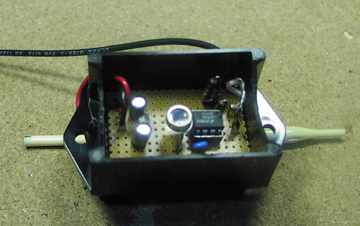
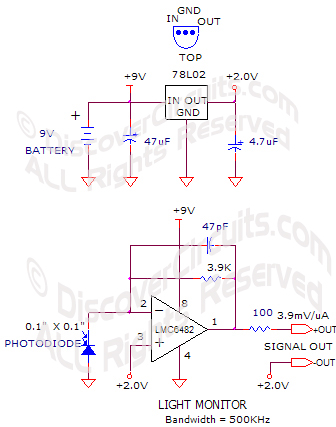
| The
hobby circuit was a simple PIN photo diode connected to a transimpedance Amp. The
electronic circuit has an upper frequency cutoff of around 500KHz. The output signal was
fed to an oscilloscope through a coax cable. |
|
It turns out that typical cool white, warm
white and kitchen lamps decay on the order of 30 milliseconds, while aquarium and full
sunlight spectrum lamps are quite fast, down to about 40 microseconds or so. A black
lamp, with no phosphor at all, decayed to 10% the peak value in about 20 microseconds.
Perhaps at some future date I will experiment with using some of these powerful light
sources to send data over a wide area, by encoding data in the modulating signal to the
lamp. |
|
 |
|
|
|
|
 |
|
|
|
|
|
|