|
DiscoverCircuits.com -- Hobby Corner
Last Updated on:
Wednesday, June 02, 2021 03:50 AM
Hobby Circuits List
The contents &
graphics of Discovercircuits.com are copyright protected.
LINK to Dave's circuit, but DO NOT COPY any files to your WEB
SITE server |
 |
|
|
|
|
|
|
|
|
Shake to Charge Flashlight --
designed
by David A. Johnson, P.E. |
|
Most white LEDs draw about 20ma of current with
a voltage of about 3.6 volts. As the voltage drops from 3.6v, the current will
also be lower. Without any regulation, the above circuit will not have a
consistent light output. I measured the LED current in this circuit at only a
few milliamps, even after many minutes of vigorous shaking. This suggests that
they decided to sacrifice light intensity for light duration.
|
|
|
The human mechanical power to electrical power conversion efficiency for a
shaking device, such as this flashlight, is poor. To measure how much power
I could get from the shaking magnet generator, I first completed the flashlight
dissection process by disconnecting the coil from the flashlight circuit. I
then connected the coil to a Schottky diode bridge, made from four 1N5817 diodes.
These diodes have a much lower 0.35v drop instead of the 1.0v for the 1N4001
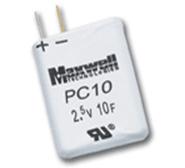
diode. I then placed a high quality 10 Farad super capacitor from Maxwell
(www.maxwell.com) across the output of the bridge. I connected a digital
voltmeter across the cap, to measure the capacitor voltage. |
 |
|
Maxwell 10F Super Capacitor |
|
|
Before the test, I made sure the capacitor was
completely discharged. I started a stopwatch, and then started shaking the
flashlight’s magnet. After 120 seconds, the capacitor was charged up to 1.0
volts. This corresponds to an energy increase of 5 joules using the equation
0.5CVV, where C is 10 Farads and V is the 1.0 volts across the capacitor. So,
I received 5 joules (watt-seconds) of energy in 120 seconds. That means that the
magnet shaking was only able to produce about 0.042 watts of power. This is a
dismal amount. To put this into prospective, a single 1.5” x 1.5 “ solar cell,
placed in bright sunlight, would generate more power than the shaking magnet
generator. I bet many of the hand crank generator flashlights I have seen for
sale would do much better. A pull string type generator would work even
better. |
|
|
|
<< Previous Page
Next Page >> |
|
|
|
Hobby Circuits List
eMail David A.
Johnson, P.E. about this circuit |
|
|