|
Algorithm Evaluates Complex Fraction - 08/03/95 EDN-Design Ideas The following algorithm uses rectangular-to-polar conversion to evaluate a complex fraction (one that includes imaginary numbers]. The algorithm is most convenient when you can perform rectangular-to-polar-coordinate and polar-to-rectangular-coordinate conversions using a calculator such an HP 11C. You can reduce all necessary Design by Paul Johnson, Hewlett-Packard, Escondido, CA
Algorithm Extracts Cube Root - 01/15/98 EDN-Design Ideas The C routine in Listing 1 generates the cube root of either a positive or a negative number. The number can range from a small fraction to greater than 1 billion. Note that this idea is irrelevant for a PC, which includes a math library with the compiler and produces a more accurate result with less effort. However, this idea is useful if you use a processor for which you don't have a math library. Design by JOHN T HANNON JR, PHILIPS CONSUMER ELECTRONICS CORP, KNOXVILLE, TN
Algorithm extracts roots of Decimal numbers - 04/29/99 EDN-Design Ideas NOTE
: Scroll to find this one. "Algorithm extracts cube root" (EDN, Jan 15, 1998, pg 100) covers only the one-third power (cube root). In contrast, the C routine in Listing 1 calculates the Kth root (X1/K) of positive decimal numbers X. Both K and X can vary widely. You type in X, K, and an estimate of the root; the routine then calls the calcRoot function in the software program. Design by Frank Vitaljic, Bellingham, WA
Algorithm Generates Random Signal - 12/05/96 EDN-Design Ideas A common way to simulate a sequence of bandwidth-limited-noise samples is to start with a sequence of uncorrelated random numbers that have a suitable distribution and then pass that sequence through a filter. Unfortunately, filtering affects the signal level, and the complexity of the filter makes computations inefficient. Alternatively, the VHDL algorithm in Listing 1 requires very little computation, Design by Ove Johansson, CelsiusTech Systems, Stockholm, Sweden
Algorithm Keeps Data Safe - 21-Jan-10 EDN-Design Ideas Prevent data loss against power blackouts and other interruptions Design by Luis G Uribe C, Caracas, Venezuela
Algorithm nulls DC offsets in DSP - 09/15/94 EDN-Design Ideas One problem associated with converting analog signals to digital samples is ensuring that the zero level of an analog signal (minus its dc offset, if any) converts to a digital sample of exactly zero. If the analog signal's zero level does not convert exactly, the converted samples retain a residual dc component, complicating processing. Design by V Solovyov, Rossiya, Russia
Algorithm tests for point location - 08/03/00 EDN-Design Ideas A recent software project approximated the phase-space trajectory (also known as a strange attractor) of a certain dynamic system by using several nonoverlapping triangles. It became necessary to determine whether particular opera Design by Lawrence Arendt, Manitoba HVDC Research Centre, Winnipeg, Canada
Algorithm Transforms Filter Coefficients - 01/21/99 EDN-Design Ideas To synsize infinite-impulse-response (IIR]-filter functions, expressed as H (z], you commonly use analog prototype-filter functions, expressed as H (s], using bilinear-z transform. This operation entails some algebraic complexity in calculating filter coefficients. The simple algorithm shown here transforms prototype-filter coefficients (W0, W1, W2]to IIR digital-filter coefficients (U0, U1, U2]. These coefficients transform from Design by Frank Vitaljic, Bellingham, WA
Algorithm Yields Precise Bessel Function - 11/09/95 EDN-Design Ideas You frequently need to determine the Bessel function of the first kind, Jn (x), for the analysis of modulated and complex waveforms. Such analyses could include, for example, routine verification of transmitter phase- or frequency-modulation indices, by the measurement of the signal-suppression terms relative to an unmodulated-carrier reference level. Another example is the evaluation of communication-channel performance through sophisticated computer simulations Design by Brian Geelen, Satellite Microwave & Communications Ltd Weert, The Netherlands
Amplifier for a Xenon Lamp Flash Detector - This circuit has a very low standby current requirement yet has very high sensitivity toward the light flashes from a xenon lamp. When connected to a flip/flop it can serve as an on on/off Controller. . . Circuit by David Johnson P.E.-February, 2002
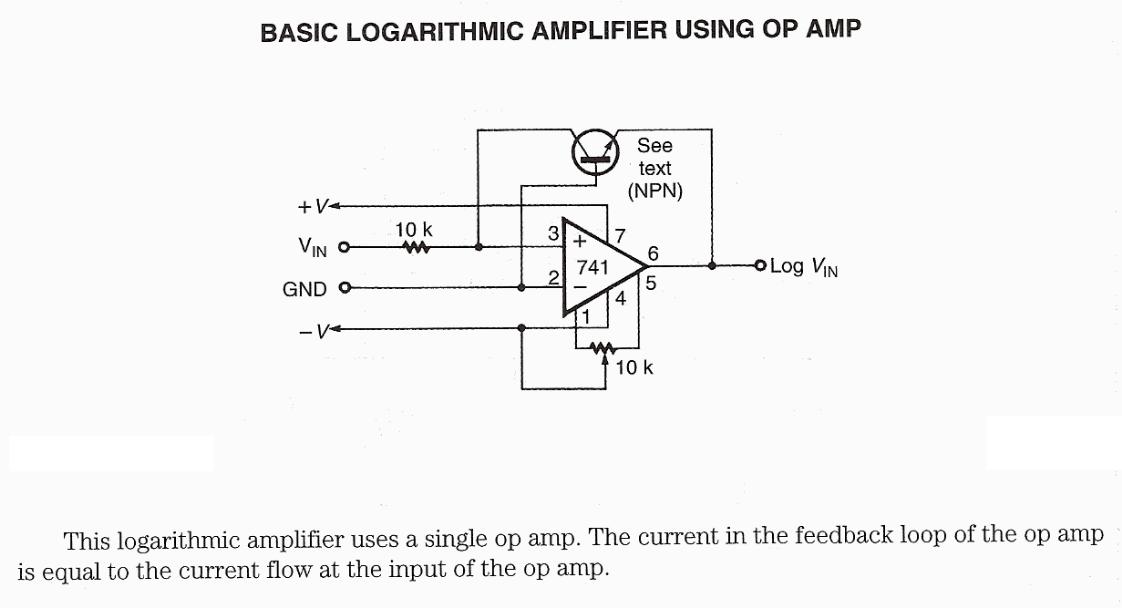
Basic logarithmic Amplifier using op-amp & NPN transistor - Schematic only
Battery Charge Current Indicator - This circuit turns on a LED whenever it detects at least 25ma of battery charge current. . . Circuit by David Johnson P.E.-July, 2006
Bodmas Rule - The term ‘BODMAS’ is an acronym for ‘bracket,’ ‘of’, ‘division,’ ‘multiplication,’ ‘addition’ and ‘subtraction’ and the ‘BODMAS rule’ is a mnemonic for the hierarchy of various arithmetical operators. A mathematical expression __ Electronics Projects for You
Circuit indicates Battery Charging Current - Anyone who has ever had a shocking experience on an especially dry day is acutely aware of the kinds of high voltage that can be generated from a simple walk across a carpeted floor. Those same finger to metal sparks can destroy or disrupt sensitive elect . . . Hobby Circuit designed by David A. Johnson P.E.-January, 2011
Circular slide rule provides quick results - EDN-Design Ideas March 26, 1998 [ NOTE
: File has multiple design, scroll for this one.] In analog-circuit design, most calculations you make need not be very precise. If you need an LED-current calculation or a coupling-capacitor value, for example, ±5% or even ±10% accuracy is usually adequate. It's sometimes inconvenient to make these calculations with a pocket calculator. For example, finding the cutoff frequency of a 3.3-kiloohms/47-pF network requires approximately 20 key presses. Design by Jacek Pawlowski, PW INMEL, Zielona Góra, Poland
DC Current Indicator #4 - The circuit below uses some common components to turn on an LED whenever DC current above a certain level is detected. The circuit uses a very popular LM393 dual voltage comparator from National Semiconductor and a common 1N4148 signal diode. The diode. . . Circuit by Dave Johnson P.E.-October, 2005
DC Current Indicator 6 - The circuit below is a simple way to indicate when DC current is flowing through a wire. The circuit is designed so it will turn on a LED indicator light, whenever the voltage drop across a shunt resistor exceeds about 0.1volts. The value of the resist. . . Circuit by David A. Johnson P.E.-October, 2005
Designing an Eight-Bit Arithmetic Logic Unit using Modelsim - This project describes the designing of an 8-bit arithmetic logic unit (ALU) using Verilog programming language. It includes writing, compiling and simulating Verilog code in ModelSim on a Windows platform. In digital __ Electronics Projects for You
Detect Short Xenon Lamp Flashes - This circuit uses a small 2.5mm square photo diode in conjunction with a 100mH coil to detect the short light flashes from a xenon lamp. The coil makes the circuit immune to normal room lights. Its 10mv sensitivity can detect light flashes from a range of over 100 feet. . . . Hobby Circuit designed by Dave Johnson P.E.-February, 2002
DSP Algorithm Measures Frequency & Damping - 10/08/98 EDN-Design Ideas The time-domain DSP algorithm described here allows you to measure the key parameters—natural frequency and damping—in linear, second-order electromechanical systems. The method applies to a range of electromechanical transducers(electromagnetic or electrostatic], including dynamic speakers, seismic geophones, micromachined sensors, and other systemsContains several designs, scroll to find this one. Design by Olga Belousova, Los Alamos, NM, and Alexander Belousov, New York, NY
Efficient Algorithm Generates Random Signal - 12/05/96 EDN-Design Ideas A common way to simulate a sequence of bandwidth-limited-noise samples is to start with a sequence of uncorrelated random numbers that have a suitable distribution and then pass that sequence through a filter. Unfortunately, filtering affects the signal level, and the complexity of the filter makes computations inefficient. Alternatively, the VHDL algorithm in Listing 1 requires very little computation, Design by Ove Johansson, CelsiusTech Systems, Stockholm, Sweden
Fast algorithm computes histograms - 10/28/99 EDN-Design Ideas A histogram is a convenient method of presenting statistical features of data; you can use a histogram for an estimate of the probability density function of a random phenomenon. To prepare a histogram entails dividing the interval occupied by data values Design by Lukasz Sliwczynski
General Purpose Arithmetic Block - This is the circuit for the general purpose arithmatic function, an Analog Computer block which solves the equation VO = (V1V2 + V3) ((RF + RG) /RG) in real time. No A/D conversions or software needed! __ Linear Technology/Analog Devices App Note, Jul 2, 2012
Genetic algorithms: programs that boggle the mind - EDN Design Ideas03/03/1997 Assume that you construct a simple device consisting of a power source and two potentiometers in series with an incandescent-light bulb (Figure 1). Assume also that you can rotate the potentiometers 180°, from -90° to +90°, and that the point of least resistance for each potentiometer is in its center (upright) position. Suppose you set the potentiometers to random positions, then you proffer the device to friends and ask them to play with it--using the potentiometers, not the supply voltage--to make the light as bright as possible. Most people select one potentiometer, turn it a little to the left or right, and note the result. Design by Clive "Max" Maxfield, Intergraph Computer Systems
|