|
1.5V to 5V 200mA Converter- Schematic only __ Designed by va3iul
1.5V to 5V Converter- In many cases can be very handy to be able to convert 1.5V to 5V. Then you can power microcontroller or LED from a single AA or AAA battery. It is simple to do this as there are special IC�s as MAX1674 or MAX7176. This is step-up DC-DC converter that can convert voltages from 0.7V to any in range from 2V to 5.5V. MAX1676 have already preset pins for 3.3 V and 5V, that makes easer integration in 3.3 and 5V circuits. IC can dissipate up to 444mW. __
10 Amp 13.8 Volt Power Supply- Sometimes amateurs like to home-brew their power supplies instead of purchasing one off the shelf at any of the major ham radio retail dealers. The advantage to rolling your own power supply is that it teaches us how they work and makes it easier to troubleshoot and repair other power supply units in the shack. It should be noted that there is no real cost advantage to building your own power supply unless you can get a large power transformer and heat sink for a super low price. Of course rolling our own gives us the ability to customize the circuit and make it even more reliable than commercial units. __ Designed by N1HFX
100 Watt inverter- Here is a 100 Watt inverter circuit using minimum number of components. I think it is quite difficult to make a decent one like this with further less components. Here we use CD4047 IC from Texas Instruments for generating the 100 Hz pulses and __ Designed by Radio LocMan
100W HF QRO linear Amplifier with Motorola MRF454- 100W HF Linear Amp - Schematic only, no circuit description __ Designed by © 2001 - YO5OFH, Csaba Gajdos
10mhz to 20mhz Laser Light Detector- This circuit was originally designed to detect laser light pulses for an optical Ethernet communications system. It has good ambient light immunity. . . Circuit by David Johnson P.E.-June, 2000
10W HF Amplifier with KT907- Schematic only, no circuit description __ Designed by © 2001 - YO5OFH, Csaba Gajdos
10W HF Linear Amplifier- This project and your efforts will provide you with a 0.55 3 watt input to easily 10 watt output. The two linear amplifiers are ment for use with QRP SSB/CW/FM/AM transmitters on the amateur bands 15 and 17 meters can be powered from a 12 volt DC supply. The design is a good balance between output power, physical size. The completed amplifier will reward the builder with a clean, more powerful output signal for a QRP rig when radio conditions become marginal. It has a RF-sensing circuit ( Q2) which allows the amplifier to switch on automatically when transmitting. This project uses a "classic" RF transistor. MOSFET power amplifiers are discussed and build in the near future on this website. __ Designed by ©1999-2013 Guy Roels ON6MU
12 VDC: 120 VAC Inverter Schematic- This Inverter takes 12 volt DC and steps it up to 120 volt a. c. The wattage depends on which transistors you use for Q1 and Q2, as well as the "Amp Rating" of the transformer you use for T1. This inverter can be constructed to supply anywhere from 1 to 1000 ( 1 KW) watts__ Global Village Institute for Appropriate Technology
12 Volt 15 Amp Low Voltage Disconnect (kit available)- The DAS1 is a combination manual switch and automatic dark-activated switch. It is designed to control up to 10 amps of 12V lights. A pair of high-intensity white LEDs are included in the circuit for built-in lighting. The circuit includes a low voltage disconnect circuit that prevents excessive battery discharge on battery operated systems. The DAS1 is ideal for solar powered lighting systems, it can also be used for line powered and automotive/marine applications. External 12V lights consisting of white LEDs, incandescent lamps and/or fluorescent lamps can be driven by the DAS1. __ Designed by G. Forrest Cook
12 volt battery Monitor- R1 controls the trip-point of the circuit. when the voltage falls below the trip-point, the LED lights. adjust it to the desired level. to use this circuit to monitor a 6v battery, substitute D1 for a 3.3 volt zener diode and adjust R1 accordingly. __ Designed by Andy Wilson
12 Volt Battery Monitor with LM3914- Here we will show you how to make a more advanced battery monitor using 10 LEDs ( or an LED bargraph display) and the LM3914 dot/bar display driver ( pictured above) to show the battery voltage very accurately. __ Contact Renewable Energy UK
12 Volt Battery Voltage Monitor (kit available)- The BVM1 is an ultra low power ten LED battery voltmeter circuit that is optimized for monitoring solar-charged 12V battery systems. The circuit features an expanded meter scale that displays ten color-coded voltage steps from 10.5V to 15.0V. Power is conserved by only turning on the appropriate LED for a short but bright flash once every 1.25 seconds. The LED display can be turned on continuously ( no blinking) by turning the Calibrate switch on, more battery power is consumed in this mode. The BVM1 also includes a battery low voltage beeper that warns when the battery voltage drops below a preset voltage. The beeper can be turned on and off with the L.V. Beep Activate switch. The BVM1 is protected against reverse voltage connection and is fused for safety. __ Designed by G. Forrest Cook
12 Volt Gel Cell Charger- Recently, a fellow amateur was looking for a gel cell charger which would first charge at a fixed rate and then later switch to a trickle charge when the cell was fully charged. After reviewing several catalogs and web sites, the MAX712 IC was discovered. This IC meets all the requirements for almost any type of battery charging system. The circuit in Figure 1 was designed specifically for 12 volt gel cells __ Designed by Radio Amateur Society of Norwich
12 volt Inverter-Very Basic type- This circuit will provide a fairly stable "Square Wave" Output Voltage. Frequency of operation is Mainly determined by the 220 uF Feedback Caps. Currently about 60 Hz. Various "off the shelf" transformers can be used. __ Designed by G.L. Chemelec
12 Volt Power Supply- Please operate caution when building this power supply. It is run on standard 117 ac current and under right circumstances 117 ac can kill you. Use a plastic enclosure if possible to decrease chances of short-circuiting. Don't use power supply if it's wet, and never run it without specified fuse. __ Designed by Andy Wilson
12 Volt to 9 Volt DC Converter- To get a more precise output voltage, replace zener diode Z1 with 10V and R1 with a 1Kilo ohm potentiometer. A Coolrib for Q1 is optional but highly recommended. You can replace Q1 for a more robust type to get more output amps depending on your requirements. Simple circuit to power your 9 volt cassette recorder and other stuff __ Designed by Tony van Roon VA3AVR
1296MHz high gain Amplifier- Schematic only, no circuit description __ Designed by © 2001 - YO5OFH, Csaba Gajdos
12kv Power Supply- If you need about 12, 000 volts DC for an ion generator this circuit might be the ticket. It draws power from the 120vac power line but it uses a small 6KV camera flash trigger coil. The output signal is isolated from the power line. . . Circuit by David A. Johnson P.E.-March, 1999
12V 20-120W Solar Panel Simulator- How do you test or develop a solar charge controller such as the unit described in SILICON CHIP last month? You could use a solar panel but then you are at the whim of the weather and time of day. Also you would need several panels of different sizes to test it properly. This device solves all those problems.__ SiliconChip
12v Cooling Fan Thermostat- This circuit will turn on a 12v DC powered cooling fan when the air temperature reaches a certain high temperature and will keep the fan turned on until the temperature drops below a second lower level. Both the high and low temperatures are both adjustable. . . Circuit by David A. Johnson P.E.-February, 2011
12V DC to 220V 100W Inverter with 4047 IC & IRF540- This is 100W inverter circuit. It uses 4047 IC and IRF540 MOSFET instead of 2N3055 transistor. Power output is 100W from 2-3A transformer. __
12V PWM Motor/Light Controller- The diagrams are for 12V operation only and there are high side ( common ground) and low side ( common +12V) versions. The low side version of the circuit uses an N Channel FET, the high side version of the circuit uses a P Channel FET. N Channel devices tend to handle more current than P Channel devices, they are also less expensive. The high side version of the circuit is useful when one side of the load has to be grounded __ Designed by G. Forrest Cook
12V to 110V/ 220V 500W Inverter- Using this circuit you can convert the 12V dc in to the 220V Ac. In this circuit 4047 is use to generate the square wave of 50hz and amplify the current and then amplify the voltage by using the step transformer. How to calculate transformer rating The basic formula is P=VI and between input output of the transformer we have Power input = Power output For example if we want a 220W output at 220V then we need 1A at the output. Then at the input we must have at least 18.3V at 12V because: 12V*18.3 = 220v*1 So you have to wind the step up transformer 12v to 220v but input winding must be capable to bear 20A. __
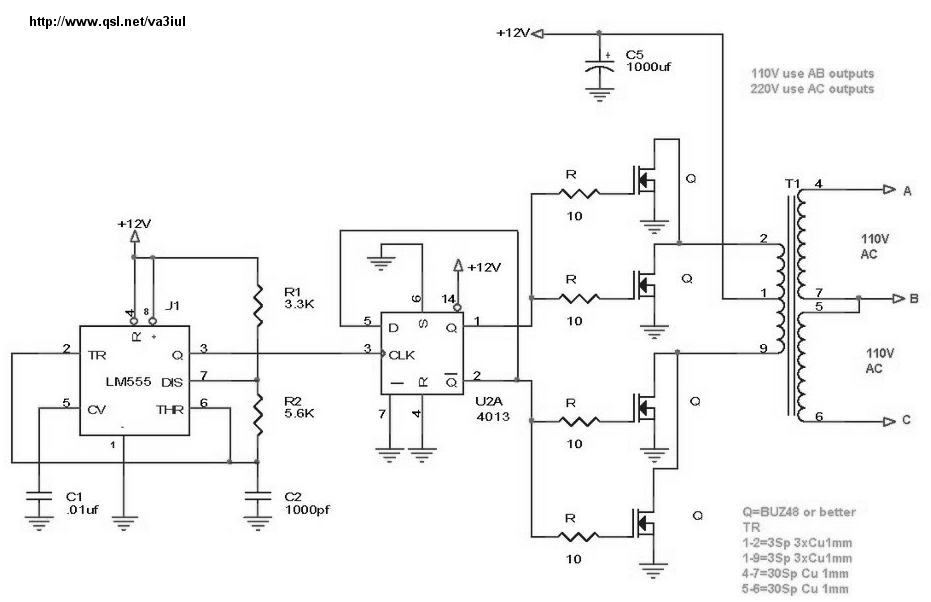
12V to 110V/220V DC-AC 300W Inverter- Schematic only __ Designed by va3iul
12V to 120V Inverter- This Inverter takes 12 volt DC and steps it up to 120 volt a. c. The wattage depends on which transistors you use for Q1 and Q2, as well as the "Amp Rating" of the transformer you use for T1. This inverter can be constructed to supply anywhere from 1 to 1000 ( 1 KW) watts __ Designed by Aaron Cake
12V to 220V 100W Inverter- This is a simple 100W inverter that can be used to achieve 110V or 220V from 12V. Circuit uses 2N3055 output transistors that are easily available. Output voltage depends on the type of transformer being used. __
12v to 240v Inverter- This circuit will produce 240v at 50Hz. The wattage will depend on the driver transistors and transformer. __ 555-Timer
12V, 4-AA Cell Differential Temperature Charger- This project makes a number of improvements over my Temperature Controlled NICD Charger circuit. The new circuit runs on 12VDC, allowing it to be used in a car or from a 12V solar power system. Additionally, a current sensor LED verifies that the cells are receiving charging current. Note that the current sensor circuitry __ Designed by G. Forrest Cook
12W AC-DC Flyback converter- Fully assembled and tested power supply with DC containing all design documentation Features: Universal AC line input, 0-1A IoutAT12V, 84% efficiency at high line, Short Circuit protection, Over Voltage protection__
13,8volt 12/20/22A Power supply with BDX33 or 2N3055- This is an easy to make power supply which has stable, clean and protected output voltage. The overall dimensions can be kept ( relative) small by using TO220 darlington BDX-33 transistors. Using 3 BDX-33 darlington transistors is almost 3 times the amount of amps then the power supply delivers, making it real though to brake ;). Although you could use this design to deliver 20 amps ( with almost no modifications and with a proper transfo and a huge heat sink with a fan) , I did not needed such much power. __ Designed by Guy Roels ON6MU
13,8volt heavy duty 30 Ampere Powersupply- Ham Radio - Power Supplies - Schematic __ Designed by Guy Roels ON6MU
13.8 Volt, 20 Ampere linear power supply- A semi-traditional power supply for communication equipment, using negative-rail regulation with grounded pass transistors in a configuration that gives some unique advantages. __ Designed by Manfred Mornhinweg
13.8 Volt, 40 Ampere switching power supply- A heavy duty, highly efficient, small and lightweight power supply specially designed for use with communication equipment. This article was originally published in the QST magazine. Includes text, schematic diagram, printed circuit board layout, and some photos. __ Designed by Manfred Mornhinweg
13.8V 20A Power Supply- Regulated DC power supply, short circuit safe, and with current limiter. This PSU has been especially designed for current-hungry ham radio transceivers. It delivers safely around 20Amps at 13.8V. For lower currents, a separate current limiting output, capable of 15ma up to a total of 20A has been added. Let us see what we have got here. The power transformer should be capable to deliver at least 25A at 17.5 to 20V. The lower the voltage, the lower power dissipation. __ Designed by Bob
13.8V 30-40A Power Supply- Schematic only, a powerfull power supply for my amateur radio equipment using four HEX FET transistors for regulation. Text can be found at: http://www. Agurk.dk/bjarke/Projects/PowerSupplyFET/PowerSupplyFET.htm __ Designed by Bjarke Korsgaard
13cm power Amplifier- Schematic only, no circuit description __ Designed by © 2001 - YO5OFH, Csaba Gajdos
|