Low cost Atmel in-system programmer- I found the schematic of this programmer in my "AVR software and technical Library - April 2003" CD-ROM and decide to publish it. The reason was, that this programmer is very stable and works perfect with AVR Studio 4. I had tested it before published it, with AT90s2313 and its worked fine!!!
To work this programmer you must to connect a crystal 4MHz to slave device at the XTAL1 and XTAL2 pins, or if you have an device with internal oscillator (AT90S2343, ATmega161 etc) and its enabled , it’s not need any external oscillator. __ Designed by © Vassilis SerasidisMake a printer port EEPROM programmer & dongle- 05/13/04 EDN Design Ideas: You can easily use a PC's printer port for serial-EEPROM programming. You can use a device-programmer circuit used to program the MicroWire serial EE-PROM 93CXX (Figure 1). The circuit is so simple that any further simplification se Design by GY Xu, XuMicro, Houston, TX
Measure Software-Execution Timer- 03/17/94 EDN Design Ideas: Especially helpful for developing real-time application programs, the circuit in Fig 1 plugs into a PC printer port and measures the execution time of a piece of software. The CD4536 is a 16/24-bit binary counter with a built-in oscillator. This counter has an 8-bit prescaler, which the chip bypasses if the 8_BY pin is high. When this is the case, the CD4536 is a 16-bit counter, and its A through D inputs select which bit is connected to output DO. If the 8_BY pin is low, the CD4536 is a 24-bit counter and the inputs select Design by Yongping Xia, EBT Inc, Torrance, CA
On and Off Programmable Controller for 3-Phase Motor- Automatic on/off controller for a 3-phase electric motor can be made with a programmable time switch. In this case a maximum of eight time durations can be programmed. The system has two...__ Electronics Projects for You
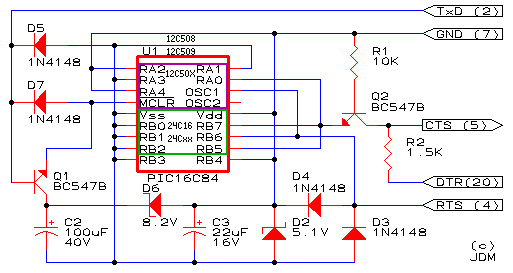
PIC micro programmer- Schematic Only __ Designed by Peter Averill
PIC Micro Programmer-MAC, Win98, XP, Vista, DOS, Linux, etc- This programmer requires only a basic terminal program capable of uploading an asci PIC HEX file. It does not matter what operating system or computer (MAC, Win98, XP, Vista, DOS, Linux, etc.) is used to talk to it. __ Designed by Luhan Monat - Mesa Arizona
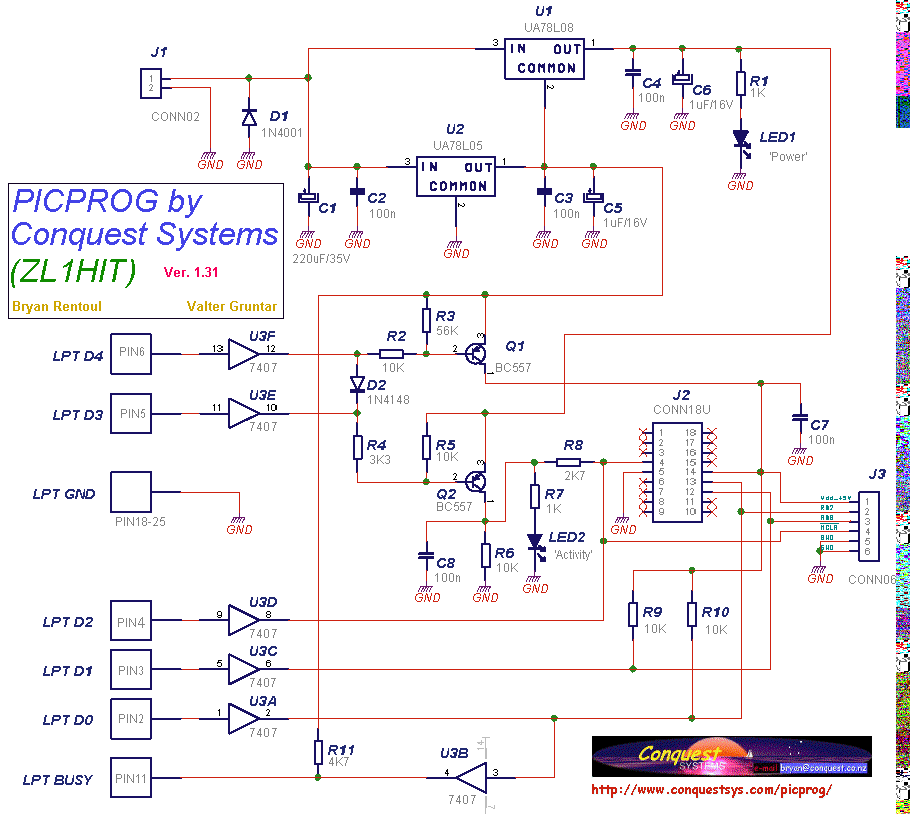
PIC Programmer- As you can see, only a few standard elements are used and the hardware is very simple to build. So here are only a few words about hardware. Supply voltage can be either AC or DC. Voltage Vdd must be between 4.5 and 5.5 V. For this purpose integrated stabilizer 78L05 (Vdd=5V) is used. It has current limitation (protection) 100 mA and with this feature protects inserted PIC from damage in case something is wrong connected. Programming voltage 13V is provided with 78L08 __ Designed by Bojan Dobaj http://www.picallw.com
PIC programmer- Essential when experimenting with PIC. Programs PIC16Fxxx series (8, 18, 28 and 40 pins) 16F84A, 16F877A, 18F452 tested successfully. Also Programs EEPROM (8 pins) type 24LCxx; Controlled by the pc's parallel printer port (SUB-D 25 pins) & IC-Prog __ Designed by Michel Bavin
PIC®Programmer- Schematic Only i use the microengineering labs u2 programmer in my own lab. This programmer connects to a USB port and gets it power from the USB port. It works well and i highly recommend it. __ Designed by Jon Fick
PIC16 DemoKit3 with programmer & displays- PIC16 DemoKit3 with programmer and displays __ Designed by Thomas Scherrer OZ2CPU
PIC16F84 Programmer- Build a low-cost and very simple serial programmer for a PIC16F84 Microchip Flash Microcontroller. Below picture is my personal writer for F84 chip, it works very nice with Nigel WPicProg V1.20. __ Designed by Wichit Sirichote
PLD code reveals PC-Board revisions- 10/17/02 EDN Design Ideas: The PLD (programmable-logic-device] code in Listing 1 implements a pc-board-level revision-detection system that detects whether PLD pins are shorted together on a pc board. It is often advantageous to field a single PLD programming file that works for several generations of physical hardware. The PLD needs to understand what the board revision is, so that it can enable or disable functions, pi Design by Clive Bolton, Bolton Engineering Inc, Melrose, MA
Precision programmable current source uses two ICs- EDN Design Ideas: 11/20/2015 Here are some programmable current source Design Ideas - which make good use of precision on-chip component matching Design by Stefano Salvatori & Pietro Oliva
Program Converts Hex to Floating Point- 07/20/95 EDN Design Ideas: You might need to use floating-point variables in some embedded software algorithms. You'll find this easy to do because all modern C compilers come with a floating-point library. However, when you're debugging a routine, you sometimes need to "peek" or "poke" a floating-point variable when all you have available is a hexadecimal interface. This scenario Design by John Santic, Consultant, Frederick, MD
Program converts temperature from RTD sensor- 06/05/97 EDN Design Ideas: 100V, platinum resistance-temperature-detector (RTD]sensor provide as an accurate means of obtaining temperature readings. Platinum sensors have a nonlinear resistance-vs-temperature characteristic; therefore, for Design by Robert Ruehle, Relco Products, Denver, CO
Program Designs single-supply op-amp- 10/26/95 EDN Design Ideas: Mathematically, there is no difference between single- and dual-supply op-amp designs, except for the signal reference. Dual-supply designs inherently reference signals to ground. However, you must use biasing to reference signals to ground in a single-supply design, because the signals are inherently referenced to VCC/2. This requirement for external bias schemes complicates the design procedure. The Basic program, which you can download from. Design by Ronald Mancini and Dave Culver, Harris Semiconductor, Melbourne, FL
Program Flags Dangerous DOS Commands- 02/02/95 EDN Design Ideas: Windows users still perform many small housekeeping tasks, such as renaming, moving, or deleting files, by switching to DOS, because DOS is much faster than the time-consuming, icon-driven facilities of Windows. However, you should Design by M N Jayaram, BARC, Bombay, India
Program generates Braille dot code- 12/19/96 EDN Design Ideas: The Basic training program in Listing 1 helps visually handicapped people easily learn Braille dot code with the help of a trainer. The trainer generates six-pin Braille code using six solenoids operating on an LPT1/2 either by directly connecting the low-power solenoids to the data bits of the parallel port or by driving solenoid pins (pull-out type] using an UN2003 power driver (Figure 1). Push-in type solenoids require complemented (0 for 1 and 1 for 0] Braille-code data bits or an extra inverter on the LPT1 port Design by Jose Carlos Cossio, Santander, Spain
Program Helps Convert OrCAD Libraries- 09/14/95 EDN Design Ideas: A simple Borland Turbo C 2.00 program, BIT2VEC. C, is useful for anyone using OrCAD SDT CAE software. The program, which you can download from EDN's FTP server (DI #1755], helps to convert OrCAD libraries from bit map to vector format Design by Vincenzo Carlotti, Roland Europe SPA, Acquaviva Picena, ITALY
Program Matches Filter-Network Impedances- 07/20/95 EDN Design Ideas: In RF circuits, it's often necessary to match one impedance to another. The program in the Listing 1 can design a network to match any resistive impedance R1 to another R2 (where R1 is less than R2] at a specified frequency and specified Q. The program employs a lossless (in theory] network that uses just capacitors and inductors. Five matching networks Design by David Kirkby, University College, London, UK
Program provides integer to binary Conversion- 03/02/98 EDN Design Ideas: (File had multiple circuit ideas. Scroll to find this one.) Binary numbers rarely appear in applications of C or C++ programs, so any reference to converting from an integer to a binary number is usually relegated to a few simple examples in the appendix. However, when you're working with codes for communication systems, terms such as parity, checksum, distance, weight, and block codes are much easier to verify with a check solution when they are in binary form. Design by Bert Erickson, Fayetteville, NY
Program provides ISA-Bus DLL for Window- 09 May- 96 EDN Design Ideas: Windows commonly uses a dynamic link library (DLL]to create subroutines and procedures that all compatible software can call. A DLL is an executable file, with extension. DLL, that a program can load and unload as required. However, not all Windows-based software can read from and write to the ISA bus in a PC. The DLL described here provide as 8- and 16-bit I/O reads and writes to the ISA bus Design by Paul Kemp, NASA Johnson Space Center Houston, TX
Program turns PC sound card into a function generator- 09/02/99 EDN Design Ideas: You can use a low-cost PC sound card as an analog-function generator by controlling the PC with the program "SoundArb. " [To obtain SoundArb, download di2409setup. exe, a 1.06-Mbyte self-extracting installation program. ] Design by David Sherman
Programmable LCD counter with memory backup- This counter based on AT90S1200A its programmable and when shut it down its keeping the current counts to the memory, until to the power on. __ Designed by © Vassilis Serasidis
Programmable 3 phase Controller for ON/OFF Motor- Automatic on/off controller for a 3-phase electric motor can be made with a programmable time switch. In this case a maximum of eight time durations can be programmed. The system has two...__ Electronics Projects for You
Programmable analogs yield single-chip sinusoidal oscillators- 01/19/06 EDN Design Ideas: Internally programmed low-pass filters yield classic RC oscillator Design by Stefano Salvatori
Programmable charger fills capacitor banks- 10/08/98 EDN Design Ideas: (Several Design Ideas, scroll to find this one.) Designed for the use with a pyrotechnic pulse generator, the charger in Figure 1 uses low-cost components to charge the C1 capacitor bank to a voltage as high as 75V, or to 25V in a few seconds. A 555 timer, IC1, controls a flyback converter via the Q1 transistor switch. The converter draws its charging current from a 5V supply. Design by Dennis Feucht, Innovatia Labs, Townville, PA
Programmable Clock Oscillator- PIC-Tock video clock using a PIC16C61.Voltage controller oscillator that was designed as a wide range oscillator to generate clock pulses for a stepper motor drive system, frequency could be varied over1,000,000:1 __ Designed by Richard Torrens
|